
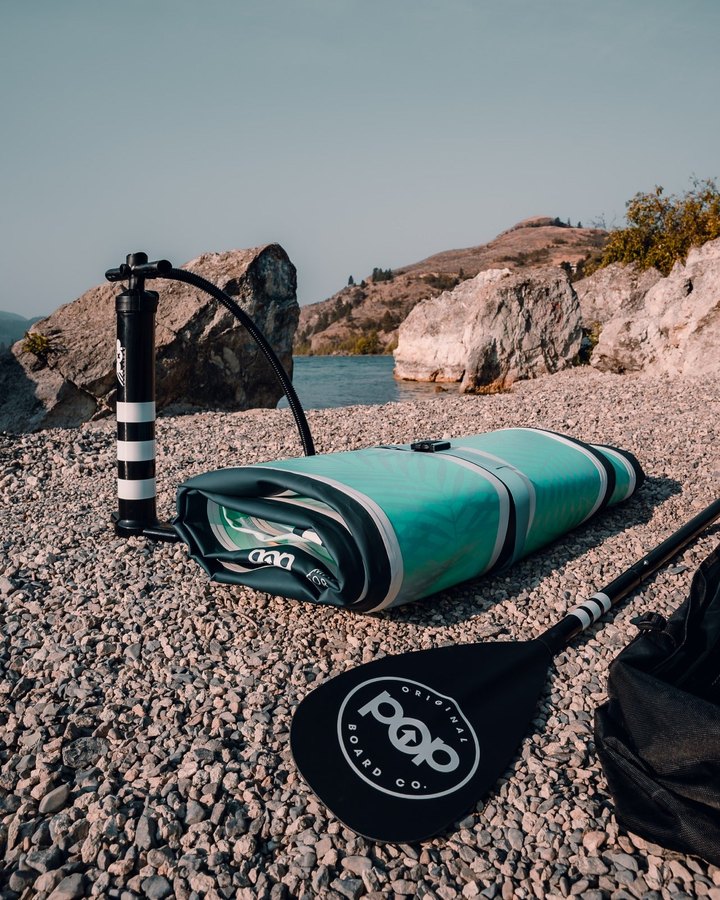

"Year ZERO. We have a wild idea. What if we built a watersports brand around everything my family and I love to do: surfing, paddling, boating, fishing, diving, and floating? And what if we made that brand accessible to everyone, everywhere?"
That's the line across the Pop Board Co About page. Year ZERO, a Santa Ana garage, one family, one idea.
Thirteen-plus years later, here's what a complete Pop Board Co lake day actually looks like.
Not a wishlist. Not a generic "best of" list. The actual sequence: the inflatable paddle board that goes in the truck first, the dock that gets anchored at 11 a.m., the catamaran that pulls up in the afternoon, the pump that keeps the setup moving, and the small accessories that quietly decide whether the day works or doesn't. We built this catalog as a system. Here's how the system runs from sunrise to sundown.
Quick answer: A complete Pop Board Co lake day kit starts with one inflatable paddle board, usually the 11' Yacht Hopper or the 10'6" Royal Hawaiian Palm, adds the POPUP Dock 8 x 7 as the floating basecamp, and steps up to the 10' Rover Marine Battle Cat when you want a real inflatable catamaran in the mix. Start small. Build the kit over seasons. Measure storage before you buy, not the storage you hope you have, the one you actually have.
5:30 a.m. Pack the truck. The whole kit fits.
The first reason this setup works is boring in the best way: it fits in a vehicle when you pack deliberately.
An 11-foot hard board is a roof-rack negotiation. A rigid dinghy is a trailer problem. A permanent dock is a construction project. The Pop Board Co catalog was built around a different idea: deflate it, roll it, bag it, and bring the water day with you.
We are the team behind the inflatable dock movement, and we built that category for exactly this reason. We were tired of the storage tax. We have always been seen as the taste-makers in our industry, from digitally printed paddle boards to inflatable docks and now the Rover Marine boat lineup on Pop Board Co. Every product in this kit was built around one practical constraint: it has to pack down and follow you to the launch.
Pre-dawn checklist for the full setup
- Two inflatable paddle boards in their included wheel bags or compatible board bags.
- The POPUP DOCK 8 X 7, rolled and ready with its carrying setup.
- The 10' Rover Marine Battle Cat in its storage package, with two-person handling planned for the full kit weight.
- An electric pump, charged the night before, plus the hand pump from the box as backup.
- A small dry box for paddles, leashes, fins, repair gear, valve tools, sunscreen, snacks, and the little parts that love to disappear.
- Marine-rated dock line, a small anchor matched to your bottom type, and proper clips or shackles from a marina, marine supplier, or outdoor retailer.
- Properly fitted, U.S. Coast Guard-approved PFDs for every person, plus kid and pet PFDs where needed.
That is the whole day in bags, bundles, and a dry box. Born in Santa Ana. Built for the trunk, the garage, the dock locker, and the kind of lake morning that starts before the coffee has finished working.
7:00 a.m. Morning launch. The Inflatable Paddle Board goes in first.
The water is glass at this hour. Nobody else is on the lake. The first board off the truck depends on what you came to do, and we have built three inflatable paddle board lanes that each handle a different morning.
If you came to tour
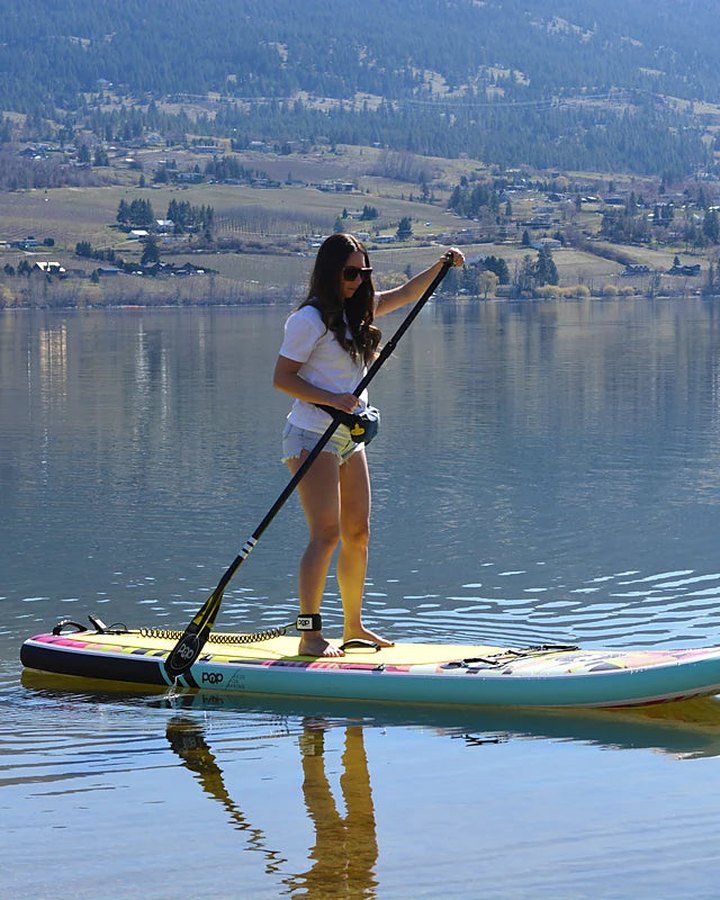
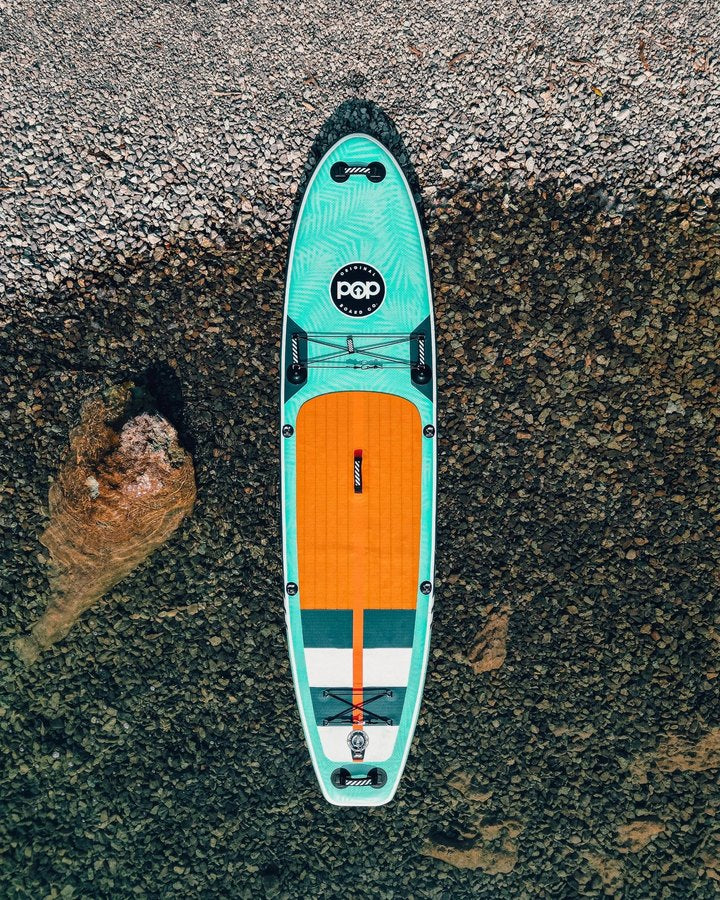
The 11' Yacht Hopper in Mint/Teak/Blue is the morning-glide board: an 11' x 32" touring shape, drop-stitch build pumped to 15 PSI, front and rear cooler mounts, extra D-rings for gear, and a complete kit with adjustable paddle, high-capacity pump, coiled leash, repair kit, and backpack carry bag.
The Yacht Hopper is built for the weekend warrior: the rider who wants to get out on the water and have fun without overthinking it. If your morning involves a longer paddle to a quiet cove with coffee and a sandwich strapped to the deck, this is the board.
Bold-color version available too: the 11'0" Yacht Hopper Inflatable Touring Paddle Board in Turq/Neon/Pink is the same 11-foot touring-friendly idea with louder personality for paddlers who want to be seen from the parking lot.

If you came to fish
The 11'6 El Capitan Bomber inflatable paddle board is the answer. P-51 Mustang shark-mouth nose art over green camo. A 36-inch-wide platform. 450 lb listed capacity. Daisy-chain gear tie-downs for a tackle bag, rod tube, small cooler, or milk crate of gear. The Bomber is the board you bring when the morning plan includes a shoreline, a topwater bite, and a little more gear than a normal cruise.
It is not a whitewater fishing board, and it is not pretending to be. It is a calm-water fishing paddle board for lakes, harbors, protected bays, and mellow river mouths where stability, deck utility, and tracking matter.
If you came to chill
The 10'6 Royal Hawaiian Palm inflatable paddle board is the casual-day board. Palm graphic, shorter waterline, easier turning, and a friendlier all-around shape. It is great for guests who have never paddled before, older kids who can manage a real board with supervision, and the second board in the truck that nobody fights over because everyone wants a turn.
Trying to figure out where to put any of these boards in the water? The full Pop Board Co blog is where our destination and buyer guides live as they go live. Start with the board that matches your water. Wind matters more than vibes.
7:08 a.m. Inflation. The pump that keeps the morning moving.
The through-line of the lake kit is not magic. It is inflation planning.
An electric pump is the parking-lot hero for paddle boards and docks. Pick one with auto-shutoff, a deflation mode, and the right valve adapter, and a full-size board usually takes about 8 to 10 minutes. See pumps and gear.
That changes the whole morning. Connect the pump to the board, set the recommended pressure from the valve or product materials, press start, and use the pump time to grab paddles, check the leash, and move gear to the shoreline. Repeat for the second board. The pump does the parking-lot work so your shoulders can do the paddling.
Pro tip: throw the Dual Action Hand Pump in the dry box as a backup. Batteries die. Hand pumps do not.
9:30 a.m. Anchor the dock. The Party Barge takes the middle.
By mid-morning, the water is busy enough that you want a basecamp. This is what the inflatable dock was built to be.
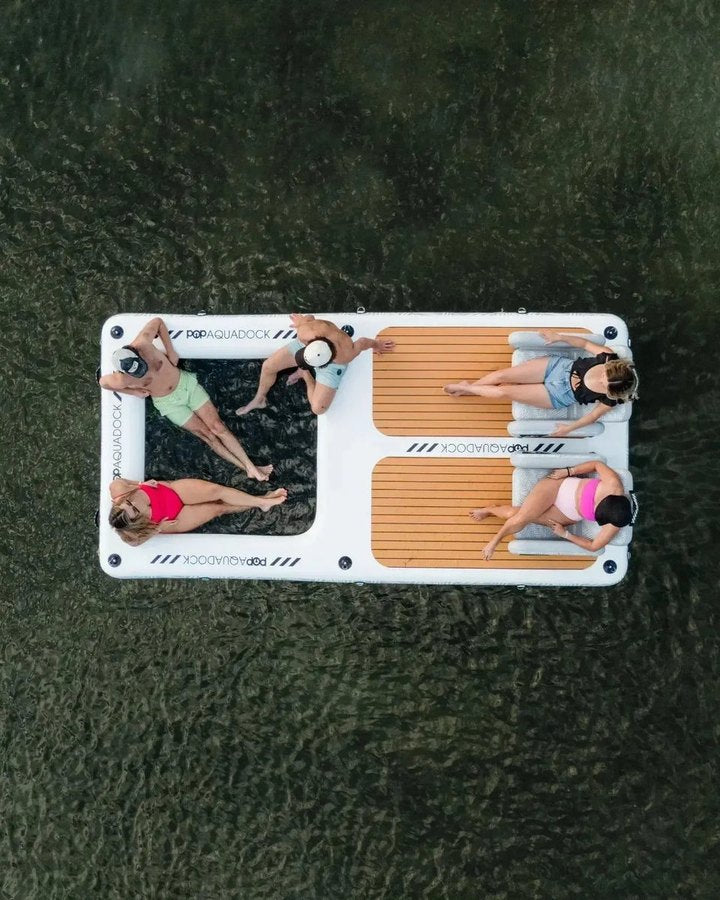
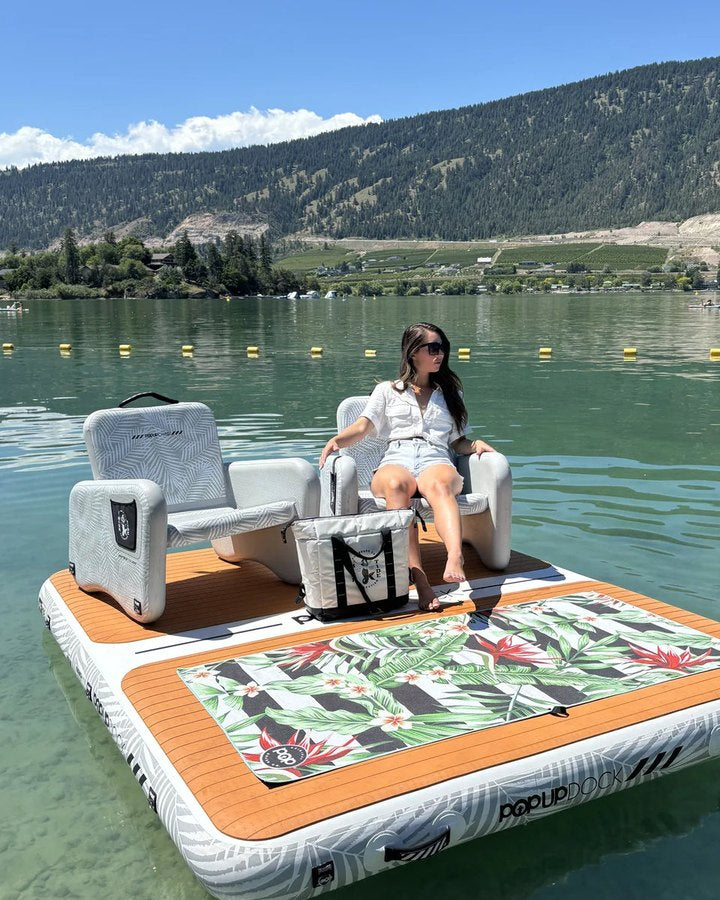
The POPUP Dock 8 x 7, aka The Party Barge, is the flagship dock in the Pop Board Co lineup: 8' x 7' x 8", 56 sq ft of floating platform, rated for 1,500+ lbs, with 14 stainless D-rings, a teak-style traction pad, a beer-pong template on the bottom, and a dual-action hand pump, carrying strap, and repair kit in the box. It is the floating living room everyone swims back to.

If you are rolling with a bigger crew, the 14' AquaDock is the bigger lake-house platform, with a net lounger built in and a 2,000+ lb rating. If you want a lighter cooling lounge, the 8' POPUP AquaNet has a mesh net center and weighs 29 lbs. If you are attaching a platform to a yacht and want the full teak-style deck, the 14' Yacht Dock is the marina version, rated for 3,000+ lbs.
Anchoring is a four-step ritual once you have done it twice
- Inflate to the dock's recommended pressure. Use the included pump, a compatible electric pump, and the PSI guidance from the product materials. Do not overinflate because louder dock talk said to.
- Float it to your spot. Keep the dock away from propellers, ladders, sharp hardware, rocks, barnacles, fish hooks, and anything that looks like it wants to chew PVC.
- Secure it with proper marine hardware. Use marine-rated dock line, an anchor matched to your bottom type, and appropriate clips or shackles from a marina, marine supplier, or outdoor retailer. The Dock & Plank Strap is a replacement carrying strap, not an anchoring strap.
- Control the far end. A second stabilizing line or small anchor keeps the dock from swinging into a boat hull every time wake rolls through. A dock is only fun if everyone can climb back on it.
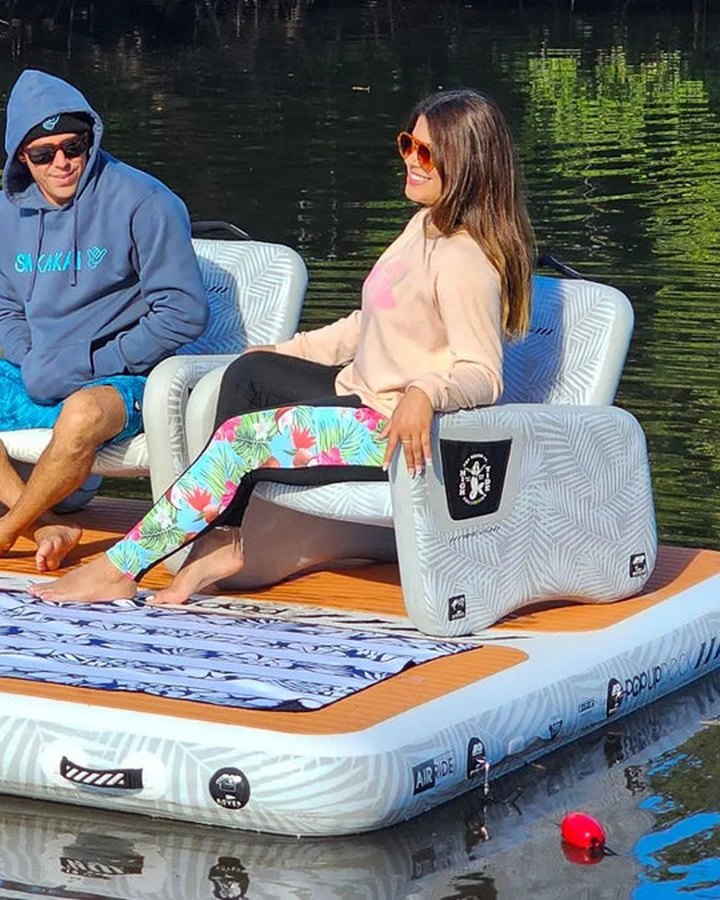
The POPUP Chair Set Grey/White is the lounge upgrade: two inflatable chairs with cup holders, D-rings, and 300 lb capacity per chair.
If the day in question happens to be a holiday weekend, this same setup becomes the whole party plan: dock in the middle, boat as the kitchen, boards as the shuttle, kids supervised in PFDs, adults off the crowded deck, and the cooler somewhere it is not blocking the ladder.

2:00 p.m. The boat. Rover Marine pulls up to the platform.
The afternoon belongs to the Rover Marine lineup on Pop Board Co: Military-Grade Tech. Radical Aesthetic. Born in Santa Ana, CA.
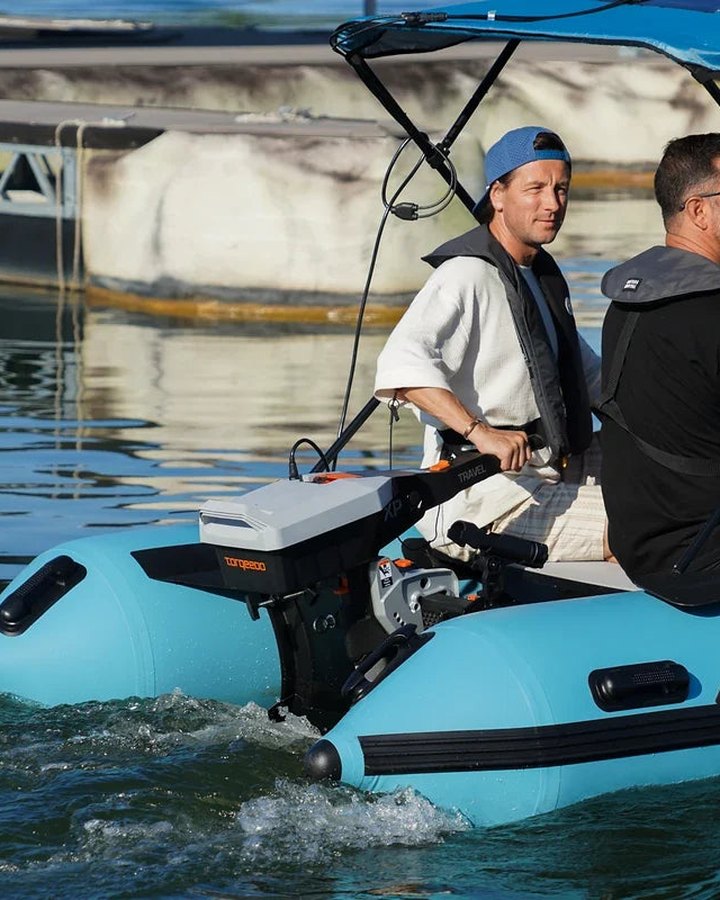
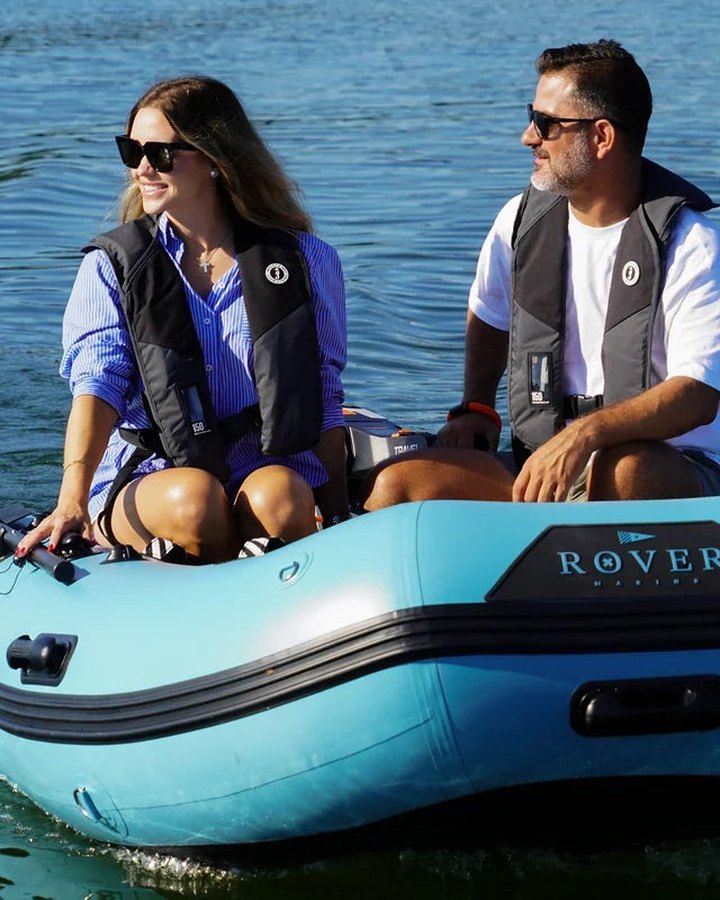
The headline boat is the 10' Rover Marine Battle Cat: 10 feet long with a 5-foot beam, 4 passengers, 1,000 lb capacity, a short-shaft outboard up to 10 hp, V-TEAK flooring, T3 woven PVC with thermally welded seams, 3 PSI tubes and a 10 PSI floor, two padded bench seats, and the pump in the box. It weighs 98 lb and rolls up for the trunk.
That is the catamaran that pulls up to the dock at 2 p.m. with cold drinks and runs the shore shuttle when someone needs another bag of ice. Twin-hull stability makes it the family, fishing, swimming, and mixed-experience-passenger pick.
If you are the only adult on board most days and you want a tighter, more traditional single-hull feel, the 10' Rover Marine Battle Boat uses the same 10-foot idea with single-hull behavior. Same 10 hp ceiling and 1,000 lb capacity, different feel under the deck.
Going bigger? The 12' Rover Marine Battle Cat and 12' Rover Marine Battle Boat step up for larger platforms, bigger motor ceilings, and more headroom. Going smaller for tighter stowage? Browse the Rover Marine boats and catamarans collection for the 8-foot options.
Sailboat owners replacing rigid dinghies should think through davit weight, hull contact, stowage, and towing practice before they buy. The Battle Cat solves real tender problems, but it is still a boat. It still needs proper PFDs, registration or numbering where required, a sound signal, lights if operating in low light, local boating-rule compliance, weather judgment, and a sober operator.
How it all works together: the systems thinking nobody talks about
Here is the part of the pitch you do not see on competitor sites.
Most watersports brands sell you a board, then a dock, then a boat: three categories, three accessory systems, three support paths, and three totally different setup routines. Pop Board Co was built differently. We made the catalog feel like a kit on purpose.
One inflation workflow, not one magic pump
One electric pump with the right nozzles can cover the paddle board and dock side of the kit. The Rover Marine boats include their own pump, and that included boat pump is the right first tool for full boat inflation. The system is not "force one pump into every job." The system is knowing which pump belongs to which job and packing the backup before you need it.
One construction language
Drop-stitch construction is the core platform vocabulary across the inflatable paddle boards and docks. It is why the POPUP Dock feels like a real platform, not a bouncy pool toy. It is why the El Capitan Bomber can act like a stand-and-cast fishing deck on calm water. It is why a rolled inflatable can become something you actually trust under bare feet.
The Rover Marine boats bring their own inflatable boat construction story, with T3 woven PVC and V-TEAK flooring. Different category, same practical goal: packable gear that still feels serious on water.
One Pop support path
Every product in this setup lives on PopBoardCo.com, ships through the same store, and is supported by the same Pop Board Co team. Shipping is free on orders over $100 to the US and Canada; see the shipping policy for details.
One aesthetic
The reason a Yacht Hopper, POPUP Dock, and Battle Cat look right anchored together at the same lake is that they were chosen by the same eye. Palm prints, camo deck pads, V-TEAK style floors, shark-mouth graphics, teak-inspired surfaces, and loud colorways are not random. They are the Pop lane: practical gear with a pulse.
5:30 p.m. The accessories that actually make the day work
The boards, dock, and boat get the attention. The day is won or lost by accessories. Here is the small-stuff list we would not leave home without.
Paddles
The Trooper Paddle is the workhorse: a fiberglass shaft, plastic blade, and two-piece adjustable build.
The 3-Piece Carbon Fiber Paddle is the long-day upgrade. Lighter swing weight matters on mile four.
Leash
The 10 ft coiled leash is the default. Use leash choice by water type: coiled leashes can make sense on flatwater and protected water, but moving water and whitewater require different judgment, training, and often quick-release waist systems.
Fin
Bring the spare. A spare center fin costs little and a lost fin without one ends the paddling part of the day fast.
Backpack
Every POP board package includes a backpack carry bag. For a sturdier travel bag, the full-size board bag fits boards from 9'6" to 12'6".
Repair kit
The PVC Repair Kit has PVC glue, a valve tool, and a PVC patch. It lives in the dry bag forever. You may use it once a season. You will be glad you packed it.
Strap
The Dock & Plank Strap is a replacement carrying strap for rolled docks and planks, not your anchoring hardware.
Chairs
The POPUP Chair Set Grey/White gives you two inflatable chairs with cup holders, D-rings, and 300 lb capacity per chair.
If you would rather bundle, the Dock and Chair Bundle pairs the POPUP Dock with two chairs and two hand pumps, and the AquaDock and Chair Bundle does the same for the 14-foot AquaDock.
Safety baseline for a full kit
A full lake-day kit is more fun, but it is still real water. Federal PFD rules require at least one wearable PFD onboard for each person on a recreational vessel, and children under 13 must wear an appropriate Coast Guard-approved PFD while underway unless below deck or in an enclosed cabin, subject to exceptions and state rules. Start with the federal PFD carriage rule, then check your state and waterway.
For paddle boards, the U.S. Coast Guard paddle board FAQ says a stand-up paddleboard used beyond the narrow limits of a swimming, surfing, or bathing area is considered a vessel. Wear the PFD, do not just bungee it under a cooler where it helps nobody.
Check wind and weather before the dock, boards, or boat go in. The National Weather Service Marine Weather Services Program and NOAA's marine weather warnings guide are better sources than the group chat.
Leashes are contextual. The American Canoe Association paddle board leash guide explains why coiled or hybrid leashes can make sense on flat lakes, tidal areas, and slow-moving rivers, while moving water and whitewater introduce snag hazards. Flatwater advice is not river advice.
8:15 p.m. Breakdown. Pack everything into trunks. Drive home.
The whole day in reverse.
Open the dump valves on the inflatable paddle boards first while you are loading paddles, leashes, and fins. They will be soft by the time you are ready to roll. Pull the dock line, retrieve the anchor, move the dock to a clean shoreline, dock, or boat platform, open the valve, fold it cleanly, roll it tight, and strap it for transport. Do not drag it over shells, rocks, asphalt, barnacles, fish hooks, or the parking lot because you are tired.
The catamaran takes the most deliberate breakdown. Remove the motor and fuel or battery system first. Pull the benches and oars. Rinse if you are in saltwater or dirty lake water. Deflate chambers in the correct sequence from the product materials. Fold the hull cleanly and slide it into the carry bag with the repair kit and pump parts accounted for.
Total breakdown for the full kit depends on how much gear you brought, how clean the shoreline is, and how practiced the crew is. Two adults working at a normal pace can make it efficient after a few sessions, but the first time always takes longer. By midsummer, it becomes muscle memory.
Everything goes back in the truck the way it came out: board bags, dock bundle, boat bag, dry box, pump case. No trailer. No roof rack. No marina slip. No dock builder. Just gear that rolls, fits, and follows you home.
The Shop The Setup callout
If you want the short version of this list, here is the core kit that handles the 80/20 of lake days for most families:
11'0" Yacht Hopper Inflatable Touring Paddle Board, Mint/Teak/Blue
The do-everything inflatable paddle board for lake mornings, marina paddles, and quiet cove runs. 11' x 32" touring shape, front and rear cooler mounts, and a complete kit.
POPUP DOCK 8 X 7
The Party Barge, the day's basecamp. 8' x 7' x 8", 56 sq ft, holds 1,500+ lbs, 14 stainless D-rings, beer-pong template, dual-action hand pump, carrying strap, and repair kit.
10' Rover Marine Battle Cat
The inflatable catamaran tender. 10' x 5', 4 people, 1,000 lb capacity, up to 10 hp, V-TEAK flooring, and the pump in the box.
3pc Carbon Fiber Paddle
The paddle you will keep upgrading toward anyway. Lightweight, compact, and better for longer-distance paddling.
Shop the full setup through the Pop Board Co inflatable paddle boards collection, inflatable docks collection, Rover Marine boats and catamarans collection, electric pumps collection, and accessories and gear collection.
FAQ: Building your complete Pop Board Co lake day kit
Do I need a Paddle Board, a dock, AND a boat to have a real lake day?
No. Most Pop Board Co customers start with one category, usually a inflatable paddle board like the 11'0" Yacht Hopper or the POPUP DOCK 8 X 7, then add the next piece the following season. The point of building the catalog as a system is that pieces stack over time. Year one: Paddle board. Year two: dock. Year three: Battle Cat. Same launch reality, more ways to use the water.
What's the most-used product in the Pop Board Co catalog?
Families usually start with the POPUP Dock 8 x 7. It makes sense. A dock is the gateway product for families because everyone can use it: kids, adults, dogs, swimmers, paddlers, boat owners, and the person who swore they were just going to sit in the shade.
How fast can I set up the entire kit on lake morning?
It depends on how staged you are. A good electric pump inflates a full-size paddle board in about 8 to 10 minutes. The POPUP Dock takes about 10 to 15 minutes with the dual-action hand pump in the box. The 10' Battle Cat takes about 10 to 15 minutes with its included pump, and setup also includes benches, oars, motor mounting, fuel or battery checks, safety gear, and registration checks where required. Two adults working in parallel can make the full kit feel efficient after practice, but the first launch always takes longer. Pre-charge pumps the night before, stage fins and leashes in one box, and keep the small parts out of the sand.
Can the same pump really handle the Paddle Board, the dock, and the boat?
Use the right pump for the right job. An electric pump with the right nozzles is the clean option for paddle boards, docks, and compatible inflatables where valve, air volume, and pressure needs match. Rover Marine boats include their own pump, and that included boat pump should be your first reference for full boat-volume inflation. See pumps and gear. The lake-day system is not forcing one pump into every job. It is packing the right pump, the backup, and the instructions.
Is the Pop Board Co kit overkill for a beginner family?
Start with two pieces: one beginner-friendly inflatable paddle board and one floating basecamp. The 10'6" Royal Hawaiian Palm is the most beginner-friendly board in the lineup, and the POPUP Dock 8 x 7 is the platform the whole family uses. Add the Battle Cat, a second board, a carbon paddle, or chairs in season two when you know what your family actually uses. Do not buy the biggest setup because it looks impressive. Buy the setup that matches your people, storage, water, and patience.
Thirteen-plus years later
Year ZERO was 2012. A garage in Santa Ana. A family who wanted a paddleboard that did not disappoint them and could not find one. We built it. Then a dock that did not take six people to install. Then a boat lineup that does not need a permanent trailer life for the right customer. The catalog grew the way the family grew: surfing, paddling, boating, fishing, diving, floating.
Everything on this page is something we built because we wanted it for our own lake days first.
Want the deep dives? This 10-part series was built around the same kit: the El Capitan Bomber fishing guide, the Yacht Hopper touring comparison, the California paddleboarding spots roundup, the Yacht Hopper for boat owners piece, the Memorial Day Party Barge playbook, the POPUP Dock vs AquaDock vs Yacht Dock breakdown, the floating dock vs boat slip math, the Battle Cat vs Battle Boat decision guide, and the sailboat tender story. Browse the Pop Board Co blog as those posts go live.
Or skip the reading and go build your kit through the live collections: inflatable paddle boards, inflatable docks, boats and catamarans, electric pumps, and accessories and gear.
Made by US, Made for YOU. Thank you for saying YES to POP.
See you on the water.


Leave a comment
This site is protected by hCaptcha and the hCaptcha Privacy Policy and Terms of Service apply.