


8'
Two-person setup for tighter storage and smaller crews.
Dimensions: 8' × 4'
Passengers: 2
Capacity: 600 lb
Motor: Up to 6 HP
Transom: 15"
Twin pontoons. Open bow. Firm drop-stitch floor. Built for fishing, swimming, diving, tender runs and days when getting in and out of the water is part of the plan.
Battle Cat comes in 8', 10' and 12' sizes. Pick the boat that fits your crew, gear, storage space and motor.

Think about who is normally in the boat and what comes with them. Motor, fuel or battery, cooler, dive gear, fishing gear and safety equipment all count toward the total load.
The smaller two-person Battle Cat for tighter storage and lighter crews.
More room for family, fishing, diving and regular tender duty.
More deck space, more load capacity and the highest motor rating.
Compare the 8', 10' and 12' models below.
Filters
3 products

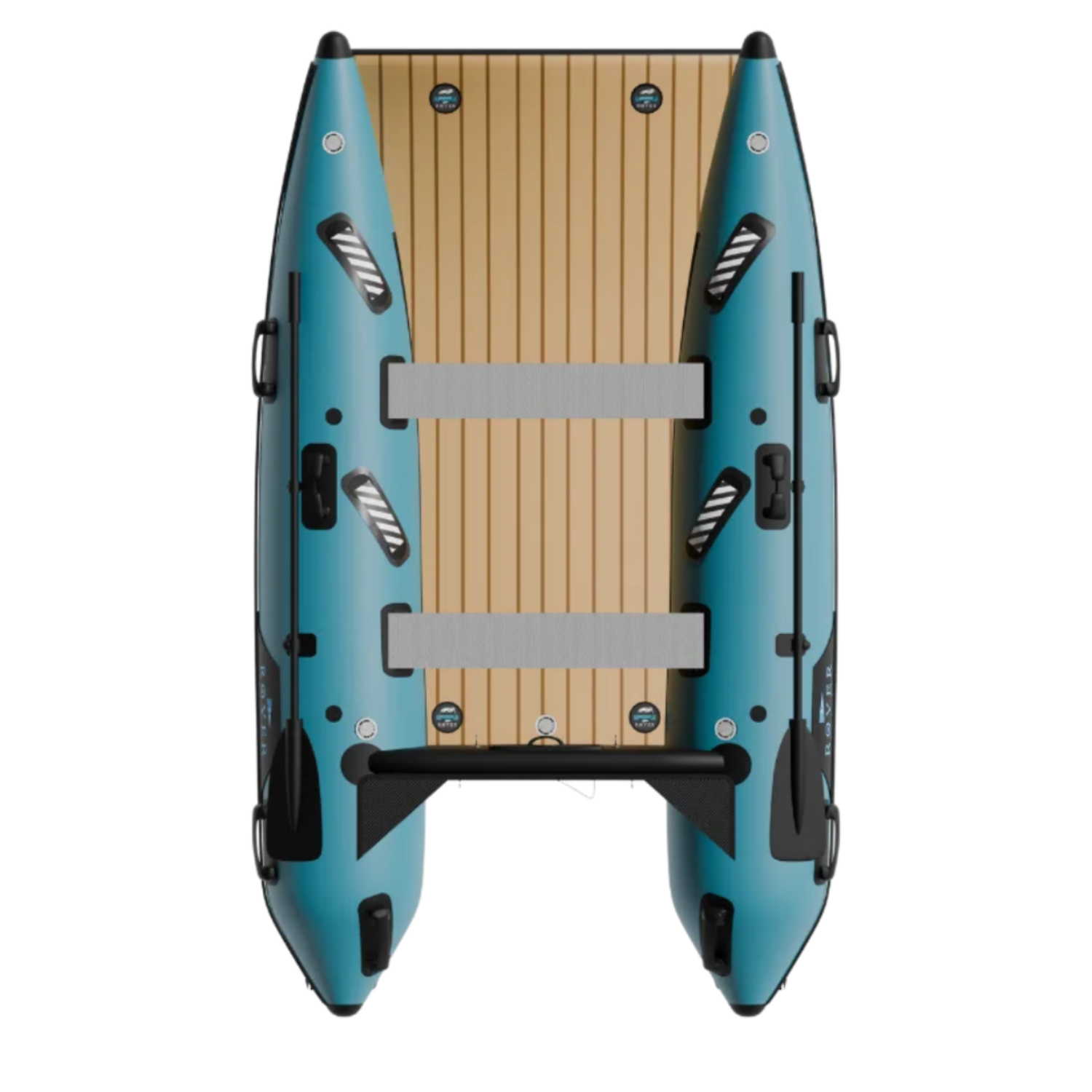

Instead of wrapping the bow into one traditional inflatable dinghy shape, the Battle Cat carries its two pontoons forward with an open space between them.
That gives the boat a wider stance and leaves the bow open for the things Battle Cat owners actually do: fish, dive, swim, load gear and climb back aboard.
It does not make the boat immune to load, waves or bad weight placement. Crew position, motor setup and conditions still matter.
The twin-pontoon layout spreads the boat across a broad stance that works well for fishing, gear and active days on the water.
The open bow gives swimmers and divers a direct route in and out instead of climbing over a fully enclosed front tube.
A high-pressure drop-stitch floor gives the crew a firmer surface for standing, sitting and moving gear around.
The Battle Cat is fully inflatable, so it can be deflated when garage, yacht or vehicle space matters.
The size jump adds room, load capacity and motor capability. The right choice is the one that fits your normal crew and gear, not the biggest number on the page.
Two-person setup for tighter storage and smaller crews.
More room for family, fishing, diving and regular tender use.
More deck room, more load capacity and access to the 20 HP rating.
Battle Cat does not close the front of the boat with one big inflatable bow tube. The space between the pontoons stays open.
For divers and swimmers, that means less climbing over the boat. For anglers, it keeps the front of the deck open. For everybody else, it is simply another place to move in and out of the water.


Fishing is one of those activities that turns an empty boat into a gear pile in about five minutes.
Battle Cat's wider stance and open deck give anglers room to organize rods, tackle and other equipment. The daisy-chain rigging and D-rings give you places to secure gear rather than leaving everything loose on the deck.
Stay within the total load rating and keep heavier gear positioned with the boat's balance in mind.
Battle Cat uses inflatable pontoons for buoyancy and a separate drop-stitch floor to create the deck between them.
Current models use T3 woven PVC with thermally welded tube seams, V-TEAK textured PVC flooring, multiple air chambers and reinforced transoms for outboard use.

The high-pressure floor gives you a firmer place to stand, sit and move around than a soft inflatable floor.
Use both reinforced EVA-padded benches, move the setup around or remove seating when more open deck space matters.
Rigging along the pontoons gives you more places to secure everyday gear instead of letting it slide around.
Multiple inside and outside handles help with boarding, launching and moving the boat on shore.
All three current Battle Cats list a 15-inch transom, but each size has its own horsepower limit.
Up to 6 HP.
Up to 10 HP.
Up to 20 HP.
Motor weight counts toward the boat's total load. So does fuel, battery weight, passengers, anchors, coolers and everything else you put aboard.

Battle Cat can handle the same everyday tender jobs: moving people, beach bags, groceries and gear between the yacht, marina and shore.
The catamaran layout makes the bigger difference when the day also includes swimming, diving or fishing. When storage matters, the boat can be deflated instead of taking up permanent rigid-hull space.
Room for rods, tackle, cooler and other gear with a wide catamaran-style stance.
The open bow is useful when fins, tanks and repeated water entry are part of the day.
Easier access in and out of the water without climbing over a full front tube.
Ship-to-shore runs, guests, provisions, beach bags and everyday marina use.
Take the family around the lake, harbor or bay while staying within the passenger and load ratings.
Harbors, bays and protected routes when weather, crew, motor setup and conditions make sense.
Current Battle Cat packages include the core gear needed to inflate, row and sit in the boat. Motors are separate unless a specific product or bundle says otherwise.
Your selected 8', 10' or 12' inflatable catamaran.
Manual propulsion for maneuvering and backup use.
Reinforced EVA-padded seating for the crew.
For the pontoons and high-pressure floor.
Basic inflatable-boat repair gear for ownership and travel.
The inflatable boat can be deflated for transport and storage.
Current Battle Cat specs list the outer tubes at 3.5 PSI and the drop-stitch floor at 10 PSI.
Current setup instructions tell owners to inflate the floor to 7 to 10 PSI until firm before finishing the pontoons at 3.5 PSI. Follow the instructions supplied with your boat and never use the floor pressure for the tubes.
Battle Cat uses twin pontoons with an open bow. Battle Boat uses the more familiar enclosed inflatable dinghy shape.
Pick Battle Cat when the wider stance and open water access fit what you do. Pick Battle Boat when you prefer a traditional dinghy and tender layout.
Rover Marine Battle Cats follow the current boat warranty structure for eligible manufacturing defects.
Limited coverage for eligible hull manufacturing defects, structural delamination and qualifying hull air leaks.
Limited coverage for eligible manufacturing defects or delamination affecting the tubes and seams.
Limited coverage for eligible bolt-on or clamp-on accessory components covered under the Rover Marine terms.
The Battle Cat is a fully inflatable twin-pontoon catamaran from Rover Marine. It uses two inflatable pontoons, an open bow, a high-pressure drop-stitch floor and a reinforced transom for an appropriately rated outboard.
Battle Cat is available in 8-foot, 10-foot and 12-foot sizes.
The 8-foot Battle Cat is rated for two people and up to 600 pounds. The 10-foot is rated for four people and up to 1,000 pounds. The 12-foot is rated for four people and up to 1,200 pounds. Total load includes passengers, motor and gear.
The 8-foot Battle Cat is rated for up to 6 HP, the 10-foot for up to 10 HP and the 12-foot for up to 20 HP.
Current Battle Cat specifications list a 15-inch transom. Confirm motor shaft length, weight and compatibility before purchasing an outboard.
The space between the two pontoons keeps the bow open, which makes water entry and exit useful for swimming, snorkeling, freediving, scuba and other activities where people repeatedly get in and out of the boat.
Yes. The twin-pontoon layout, open deck and gear attachment points make Battle Cat useful for fishing setups. Stay within the boat's total load rating and distribute people and gear appropriately.
Yes. Battle Cat can be used for ship-to-shore runs, marina trips and tender duty. Choose the size around your crew, gear, outboard, storage space and lifting setup.
Current Battle Cat specifications list 3.5 PSI for the pontoons and 10 PSI for the drop-stitch floor. Current setup instructions describe inflating the floor to approximately 7 to 10 PSI until firm. Follow the instructions supplied with your boat.
Current Battle Cat packages include the inflatable catamaran, two rowing paddles, two reinforced EVA-padded bench seats, a high-capacity inflator and repair kit. Outboard motors are separate unless a specific listing or bundle says otherwise.
Battle Cat uses two pontoons and an open bow. Battle Boat uses a traditional single-hull inflatable dinghy layout. Battle Cat puts more emphasis on a wide stance and open water access, while Battle Boat feels more like a conventional tender.
Registration rules vary by state, waterway, vessel size and whether the boat is motorized. Check the boating authority where you plan to operate the boat.
Current Rover Marine coverage includes five-year hull coverage, three-year tube and seam coverage and two-year coverage for eligible attached accessory components, subject to the current warranty terms and exclusions.
Compare the 8', 10' and 12' Battle Cats and choose the inflatable catamaran that fits your fishing, diving, tendering and boat days.