




Firm board. Better paddle. PSI matters.
A paddle board only performs when it is inflated to the right pressure. Too soft and it flexes, drags, and feels unstable. Correctly firm and it behaves like a real board under your feet.
Here is how to inflate a paddle board, how much PSI to aim for, what pump to use, and how to avoid the mistakes that make inflatable boards feel worse than they should.
How much PSI does a paddle board need?
For many inflatable paddle boards, the target range is roughly 12 to 15 PSI. That range is firm enough to help the board stay rigid, stable, and efficient without overstressing the seams.
Going below about 10 PSI usually leaves the board feeling soft, flexy, and harder to control. The nose may push water, the middle may sag under your feet, and the board may feel less stable than it should.
The number printed on your board, valve, or owner materials is the number that matters most. Do not guess. Do not inflate higher because it sounds tougher. Inflate to the recommended pressure for that specific board.
POP rule: Firm is good. Overdoing it is not. Set the board to its recommended PSI, then check pressure again if the board sits in hot sun for a long time.
How to inflate a paddle board, step by step
The process is simple, but the details matter. A valve pin in the wrong position or a loose hose connection can make setup frustrating fast.
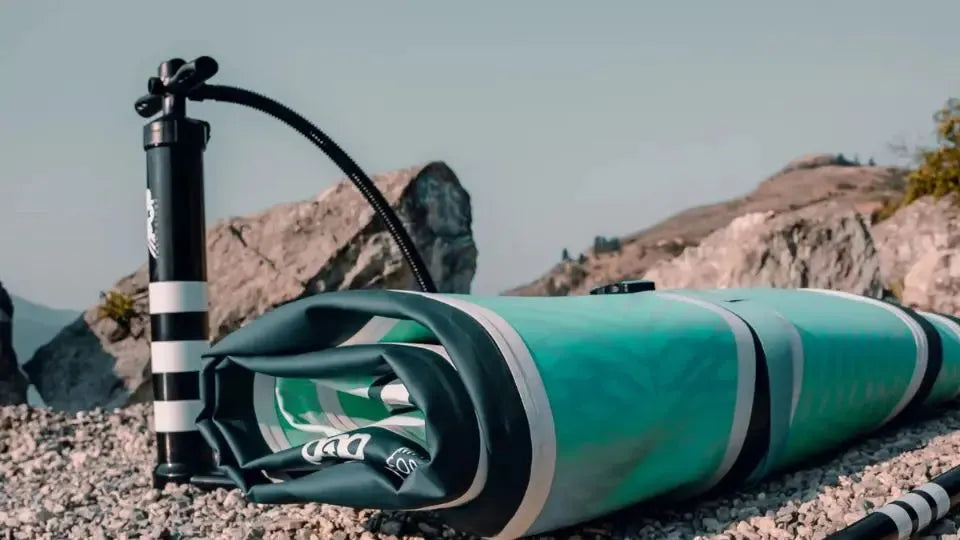
Unroll the board
Lay the board on a flat, clean surface. Avoid sharp rocks, hot pavement, and blazing direct sun during setup.
Check the valve
Open the valve cap and confirm the valve pin is in the up, closed position so air goes in and stays in.
Attach the hose
Connect the pump hose firmly to the valve. A loose connection can leak air and slow the whole process down.
Start pumping
The first part fills quickly. The final few PSI take the most effort with a hand pump because the board is firming up.
Stop at target PSI
Use the gauge. Stop at the recommended pressure for your board, then remove the hose and close the valve cap.
Finish the setup
Attach the fin, leash, and paddle. Check that everything is secure before walking the board to the water.
Hand pump or electric pump?
A quality dual-action hand pump works and does not need power. It is reliable, simple, and comes with many inflatable paddle board kits. The catch is the final stretch. The last few PSI are where the board gets firm, and that is where the hand pump turns into real work.
An electric pump removes most of that effort. You set the target pressure, connect the hose, and let the pump do the work while you prep the paddle, leash, fin, water bottle, PFD, and the rest of your gear.
Hand pump
Best for: simple setup, backup use, low-cost inflation, and paddlers who do not mind the workout.
Tradeoff: the final few PSI can take real effort, especially in heat or when inflating more than one board.
Electric pump
Best for: frequent paddlers, families, multiple boards, docks, travel setups, and anyone who wants faster setup with less effort.
Tradeoff: you need to charge it or have power available, depending on the pump model.
POP setup tip: If you inflate more than one board on a normal trip, an electric pump starts to feel less like an accessory and more like the thing that keeps everyone in a good mood before the paddle starts.
Why the SHARK 2S pump makes setup easier
The SHARK 2S Rechargeable Electric SUP Pump is built for paddlers who want less pump work and more water time. It supports pressures up to 20 PSI, has dual-stage inflation, auto-shutoff at the target PSI, and can inflate a full-size SUP in about 8 to 10 minutes depending on the board, target pressure, temperature, and starting conditions.
That matters because the pump does not just save time. It also helps you hit the correct pressure consistently, which is what makes the board feel firm, stable, and ready to paddle.
Set target PSI
Choose the correct pressure for your board instead of guessing by feel.
Auto-shutoff
The pump shuts off when the target pressure is reached, helping avoid overinflation.
Deflation mode
The pump can help remove air when packing up, making the board easier to roll tighter.
A few things that trip people up
Most paddle board inflation problems come from small setup mistakes. Check these before assuming the board or pump has a problem.
Valve pin is down
If the board will not hold air, the valve pin may be in the open position. Press and twist it to the closed, up position before inflating.
Hose is loose
If air is hissing around the valve, reconnect the hose and make sure it is fully seated before pumping again.
Stopping too early
The board may look full before it reaches riding pressure. Keep going until the gauge reaches the recommended PSI.
Hot sun pressure rise
Heat can raise internal pressure. Do not leave a fully inflated board baking in direct sun for long periods.
Wrong PSI target
Do not use a random number from another board. Use the pressure recommended for your specific board.
Forgetting the fin
Inflation is not the whole setup. Add the fin before paddling so the board tracks properly.
Watch pressure on hot days
Air expands when it heats up. That means a board inflated in cool morning air can become firmer later if it sits in strong sun or on hot sand.
If the board feels extremely hard after sitting in heat, move it into shade and release a small amount of air if needed. When you are ready to paddle again, check the pressure and bring it back to the recommended range.
The goal is simple: keep the board firm enough to perform without letting heat push it beyond its safe pressure range.
Heat rule: Never use the sun as a pump. Inflate to the recommended pressure, keep the board shaded when possible, and avoid storing it fully inflated in extreme heat.
Build the right inflation setup
The right board and pump pairing makes a big difference. A properly inflated board feels more stable, tracks better, and gives you more confidence from the first few strokes.
Inflatable Paddle Boards
Start with the right board for your size, use, and water. Stability, width, and capacity all matter once the board is inflated.
Shop Paddle BoardsYacht Hopper
A touring-minded 11'0 inflatable board for longer flat-water paddles, gear, cooler mounts, and stable adventures.
Shop Yacht HopperThe short version
A properly inflated paddle board is the difference between a stable, confident paddle and a soft, wobbly one. For most inflatable boards, aim around 12 to 15 PSI, but always follow the pressure printed on your specific board.
Check the valve pin, attach the hose firmly, pump to the recommended PSI, watch heat, add your fin and leash, and you are ready for the water.
Paddle board inflation FAQs
How much PSI does an inflatable paddle board need?
Many inflatable paddle boards are inflated to roughly 12 to 15 PSI, but the correct number is the pressure printed on your board, valve, or owner materials.
What happens if my paddle board is underinflated?
An underinflated paddle board can feel soft, flexy, slow, and less stable. It may sit lower in the water and feel harder to paddle.
Can I overinflate a paddle board?
Yes. Do not inflate beyond the recommended PSI. Heat can also raise internal pressure, so avoid leaving a fully inflated board baking in direct sun.
Why does air come out when I remove the pump hose?
The valve pin may be in the open position. Before inflating, confirm the valve pin is up and closed so air stays inside the board.
Is an electric pump worth it?
An electric pump is worth it for frequent paddlers, families, multiple boards, docks, or anyone who wants less setup effort. It helps hit the target PSI with less work.
How long does it take to inflate a paddle board?
Inflation time depends on the board, target PSI, pump, temperature, and starting conditions. The SHARK 2S product page lists full-size SUP inflation in about 8 to 10 minutes.
Inflate it right. Paddle it better.
Pair the right inflatable paddle board with a pump that fits how often you paddle, then set the correct PSI before every launch.

Leave a comment
All comments are moderated before being published.
This site is protected by hCaptcha and the hCaptcha Privacy Policy and Terms of Service apply.