

Pool toy? No. Modern inflatable SUPs are serious boards.
The question usually comes with a raised eyebrow: if it inflates, is it a real paddle board or just a bigger pool float?
Fair question. The short answer is yes, quality inflatable paddle boards are genuinely good. For many paddlers, families, dogs, travelers, and storage-limited homes, they are often the smarter buy.
Why people doubt inflatable paddle boards
The skepticism usually comes from cheap vinyl floats that fold, flex, and sag in the middle. Those products exist, and they are not the same thing as a quality inflatable stand up paddle board.
A real inflatable paddle board is built to hold shape under pressure. The difference is construction, materials, pressure rating, board shape, width, volume, and capacity. When those details are right, the board feels firm underfoot instead of soft or bouncy.
The quick filter: If an inflatable board does not clearly explain its construction, recommended PSI, size, capacity, and intended use, keep shopping. Good inflatable paddle boards are built like real boards, not toys.
What makes a good inflatable board rigid?
The key technology is drop-stitch construction. Inside the board, thousands of internal threads connect the top and bottom layers. When the board is inflated to the correct pressure, those threads help hold a flat, rigid shape instead of letting the board balloon outward.
That is why a quality inflatable board can feel surprisingly solid on the water. It is still filled with air, but it is not a pool float. It is a pressurized, shaped platform built to carry weight, track, glide, and stay stable.
Correct inflation matters. A good board that is underinflated will feel soft, slow, and less stable. Always inflate to the recommended PSI listed for your board.
Drop-stitch core
Internal threads help the board hold a flatter, more rigid shape when inflated.
Correct PSI
The board needs proper pressure to feel firm, paddle cleanly, and support its rated load.
Real capacity
Weight capacity matters for riders, dogs, kids, coolers, fishing gear, and longer days.
Where inflatable paddle boards clearly win
Inflatable paddle boards are not just a compromise for people without storage. In many everyday situations, they are simply easier to own.
Storage and transport
Inflatable boards roll into a bag and can fit in a trunk, closet, RV, boat locker, apartment, or garage corner.
No roof rack. No garage bay. No wall rack. No awkward hard-board carry after a long paddle.
Impact forgiveness
A hard board can ding, crack, or chip when it hits docks, rocks, trailers, or garage walls.
An inflatable board is more forgiving around rocky shorelines, kids, dogs, and real launch conditions.
Family stability
Wide inflatable shapes create a stable platform for beginners, larger riders, kids, dogs, coolers, and casual lake use.
For most families, confidence matters more than top-end racing speed.
Travel flexibility
An inflatable board can go in a car, rental house, boat, cabin, camper, cottage, or small storage space.
That means more chances to actually use it instead of leaving it behind.
Durability: better than people expect
Modern inflatable boards are built for real use, but durability still depends on quality and care. A good inflatable board can handle normal launches, docks, sand, grass, and family use well. It is also more forgiving than a hard board when it bumps something.
That does not mean it is indestructible. Sharp rocks, barnacles, knives, dragging over rough ground, improper storage, sun abuse, overinflation, and neglect can still cause damage. The right expectation is not “nothing can hurt it.” The right expectation is “this is tough, portable water gear that needs basic care.”
Care tip: Rinse after saltwater, dry before long-term storage, avoid dragging over sharp surfaces, keep it out of extreme heat when fully inflated, and store it clean. Good care adds seasons to the board.
The honest trade-offs
Inflatable paddle boards are great, but they are not perfect for every paddler. A hard board can still have an edge in specific performance categories.
Speed
Advanced racers and performance paddlers may still prefer a hard board for top-end glide and speed.
Responsiveness
Hard boards can feel sharper for surfing, racing, and aggressive turning.
Setup time
An inflatable board needs inflation before you paddle and deflation before it packs down.
For most recreational paddlers, those trade-offs are worth it because the board is easier to store, easier to transport, more forgiving, and more likely to get used often.
The pump changes the whole experience
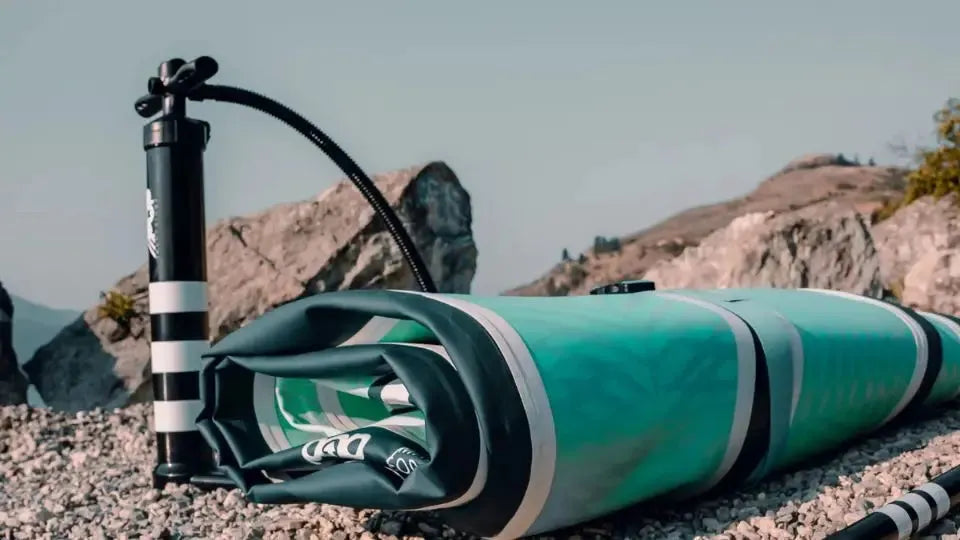
The biggest friction point with inflatable boards is not usually the board. It is the setup. Hand-pumping works, but it can feel like you are burning your first round of energy before the paddle even starts.
That is where an electric pump helps. The SHARK 2S Electric SUP Pump is built for faster, cleaner inflation with auto-shutoff and support up to 20 PSI. POP’s SHARK 2S pump review goes deeper into setup time and why an electric pump makes inflatable gear easier to live with.
Manual pump
Works fine, costs less, and gets the board ready, but it takes effort and time.
Electric pump
Makes setup easier, helps hit the correct pressure, and saves your energy for the water.
So, are inflatable paddle boards any good?
Yes, quality inflatable paddle boards are good. For families, beginners, casual adventurers, lake house owners, boaters, travelers, dog owners, and anyone short on storage, a quality inflatable board is often the smarter buy.
The key word is quality. Buy a board with real drop-stitch construction, the right width, enough capacity, the correct pressure rating, and a shape that matches how you actually paddle.
Best POP inflatable boards to start with
If you want an inflatable board that fits real-world use, start with the way you plan to paddle most often.
El Capitan Bomber
The wide, stable, confidence-first choice for beginners, dogs, kids, larger riders, fishing, and gear-heavy paddles.
Shop El CapitanYacht Hopper
The touring-minded inflatable board for longer flat-water paddles, cooler mounts, cargo, and exploring farther.
Shop Yacht HopperRoyal Hawaiian Palm
The easy-going all-around shape for casual paddling, first boards, relaxed lake days, and lighter handling.
Shop Royal HawaiianInflatable paddle board FAQs
Are inflatable paddle boards stable?
Yes, a quality inflatable paddle board can be very stable when it is sized correctly and inflated to the recommended pressure. Wider boards are usually more stable for beginners, dogs, kids, and gear.
Are inflatable paddle boards durable?
Quality inflatable boards are durable for normal paddling, travel, docks, lakes, and family use. They still need basic care and should not be dragged over sharp rocks or stored poorly.
Do inflatable paddle boards feel soft?
A properly inflated quality board should feel firm underfoot. If the board feels soft, bouncy, or saggy, it may be underinflated, overloaded, or poorly built.
Are hard paddle boards better than inflatable boards?
Hard boards can be better for advanced racing, surfing, and sharp performance. Inflatable boards are usually better for storage, transport, family use, travel, and casual paddling.
Do I need an electric pump?
You do not need one, but an electric pump makes inflatable paddle boards easier to own. It saves effort, helps reach the right pressure, and makes setup feel less like work.
Which POP inflatable paddle board is the most forgiving?
The El Capitan Bomber is the most forgiving POP board because it is wide, stable, and built for higher capacity use with dogs, kids, fishing, and gear.
Yes, inflatables are good. Choose the right one.
Modern inflatable paddle boards are real boards, not pool toys. Pick the right shape, inflate it correctly, and match the board to the way you actually paddle.


Leave a comment
All comments are moderated before being published.
This site is protected by hCaptcha and the hCaptcha Privacy Policy and Terms of Service apply.