

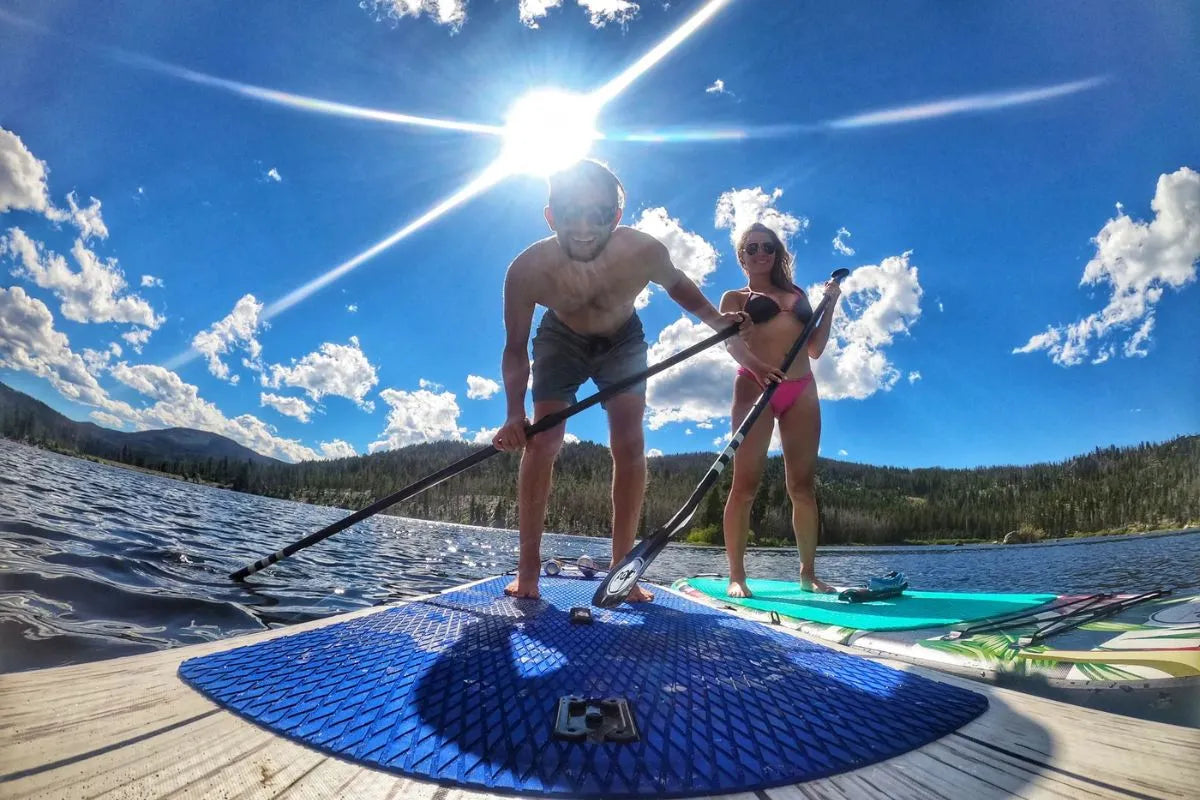
Your first paddle should feel simple. Start calm.
Paddle boarding looks harder than it is. Most beginners are standing and paddling comfortably within their first half hour when they start on the right water, with the right board, and with a simple plan.
This guide walks through what to bring, where to launch, how to stand up, how to fall safely, and how to make your first day feel like a win instead of a wrestling match.
Pick the right first-day conditions
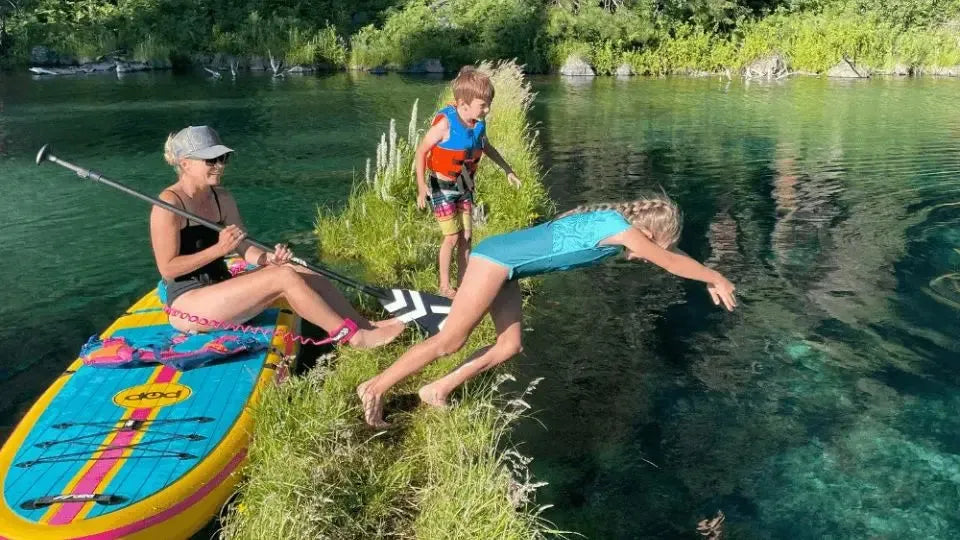
Your first paddle board session should not be a battle against the weather. Pick flat, calm water: a quiet lake, a sheltered cove, a protected bay, or a slow section of river with no strong current and no boat wake.
Wind is what ruins a first day fastest. Even a light breeze can push a beginner around, especially when you are standing upright like a sail. Morning is usually calmer than afternoon, so an early start can make the whole session easier.
Save the ocean, current, rough chop, crowded boat channels, and windy days for later. Your first outing is about learning how the board feels, not proving anything.
Good first spot
Calm lake, quiet cove, protected shoreline, slow river, or flat marina water with low traffic.
Bad first spot
Windy open water, rough ocean, strong current, heavy boat wake, cold water, or crowded launch ramps.
Best first time
Warm day, shallow launch, light wind, calm water, a friend nearby, and no rush to stand right away.
What to bring paddle boarding
You do not need a truck full of gear for your first paddle, but you do need the basics. Good first-day gear keeps you safer, more comfortable, and more likely to enjoy the learning curve.
- A wide, stable board: A forgiving all-around shape makes learning easier. The 10'6 Royal Hawaiian Palm is an easy-going all-around board for relaxed paddling and beginner lake days.
- A coiled leash: A leash helps keep the board close if you fall off.
- A personal flotation device: Wear a PFD that fits properly and meets your local rules.
- An adjustable paddle: A simple adjustable paddle lets you set the length for your height and stance.
- Sun protection: Bring sunscreen, sunglasses with a retainer, a hat, and water.
- Wet-friendly shoes: Optional, but helpful for rocky launches, hot docks, shells, or rough shorelines.
POP note: The SUP accessories and gear collection is the easiest place to look for leashes, paddles, pumps, and water-day basics before your first session.
Know the life jacket rule
This one is not optional. When a stand up paddle board is used outside a designated swimming, surfing, or bathing area, the U.S. Coast Guard treats it as a vessel. That means PFD carriage rules apply, and state or local rules may add more requirements.
In practical terms, adults should have a Coast Guard approved wearable PFD available, and children are generally required to wear one while on the board. Local rules can be stricter, so check the rules for the waterway where you paddle.
A leash is also part of smart paddle board safety. It keeps your board close if you fall, which matters because your board is your largest flotation platform.
Beginner safety rule: Wear the PFD, use the leash, stay close to shore, avoid wind and current, and do not paddle alone until you know how your board handles.
How to stand up on a paddle board
Do not rush straight to your feet. The easiest way to learn is to start low, get comfortable, and stand only when the board feels steady.
Launch shallow
Start in knee-deep water so the fin has room and you are not scraping the bottom.
Start on knees
Kneel over the center handle and paddle a few strokes to feel the board.
Plant hands
Place your hands on the deck, bring one foot forward, then the other.
Stand slow
Rise with a straight back, soft knees, and feet about hip-width apart.
Look out
Look at the horizon, not your feet. If you wobble, drop back to your knees.
First-day truth: Kneeling is not failing. It is how most people learn board balance before standing. Take a few minutes, settle in, then stand when the board feels calm.
Falling is fine
Everyone falls. The goal is not to avoid falling forever. The goal is to fall safely and get back on without turning it into a big deal.
If you feel yourself going, aim to fall away from the board and into the water, not onto the deck, rail, fin, paddle, or gear. Keep the paddle in one hand if you can, but do not fight the fall. Water is softer than the board.
Your leash keeps the board nearby. To climb back on, come in from the side near the center handle, pull your chest onto the board first, then swing your legs up. Start on your knees again before standing.
Fall away
Aim for the water, not the board. Do not try to save it at the last second.
Climb from center
Use the center area of the board because it is the most stable re-entry point.
Reset on knees
Get settled, breathe, paddle a few strokes, then stand again when ready.
Common beginner mistakes
Most beginner problems come from starting in the wrong place, standing too fast, or forgetting that wind matters more than it looks from shore.
Looking down
Looking at your feet makes you wobble more. Keep your eyes up and look where you want to go.
Standing too narrow
Keep your feet about hip-width apart and parallel. A narrow stance feels unstable fast.
Ignoring wind
Wind can push beginners away from shore. Start upwind when possible and stay close.
Paddling only one side
Switch sides every few strokes to keep the board tracking straighter.
Standing too soon
Start on your knees and get comfortable first. There is no trophy for rushing.
No leash or PFD
Beginner confidence should never replace basic safety gear. Wear the PFD and use the leash.
Best POP setup for a first day
Your first board should be stable, forgiving, easy to handle, and fun enough that you want to go again. That usually means an all-around inflatable board, a coiled leash, a PFD, and an adjustable paddle.
Royal Hawaiian Palm
A forgiving 10'6 all-around board for relaxed paddling, lake days, and beginner-friendly handling.
Shop Royal HawaiianStable Board Options
If you want more width for dogs, kids, fishing, or heavier riders, compare the full POP inflatable board lineup.
Shop Paddle BoardsAccessories and Gear
Look for leashes, paddles, pumps, safety basics, and the gear that makes first-day setup easier.
Shop GearThe short version
Pick calm water. Start on your knees. Wear a PFD. Use a leash. Stand slowly. Look at the horizon. Fall into the water, climb back on from the side, and keep going.
Your first paddle board day does not need to be perfect. It just needs to be calm, safe, and fun enough that you want the next one.
Paddle boarding beginner FAQs
Is paddle boarding hard for beginners?
Paddle boarding is easier than it looks when you start on calm water with a stable board. Most beginners start on their knees, stand slowly, and get comfortable within the first session.
What should I bring paddle boarding for the first time?
Bring a stable board, paddle, leash, PFD, water, sun protection, and wet-friendly shoes if the launch area is rocky or hot.
Do I need a life jacket on a paddle board?
When paddling outside designated swim, surf, or bathing areas, SUPs are treated as vessels under U.S. Coast Guard rules, so PFD rules apply. State and local rules may add stricter requirements.
Should I start standing or kneeling?
Start kneeling. Paddle a few strokes from your knees, feel the board, then stand slowly with your feet where your knees were.
What is the best water for a first paddle?
Choose flat, calm water with little wind, no strong current, no heavy boat wake, and an easy shallow launch.
What is a good POP board for beginners?
The Royal Hawaiian Palm is an easy-going all-around shape for relaxed paddling and beginner lake days. For extra stability, compare the full POP inflatable paddle board collection.
Ready for your first paddle? Make it easy on yourself.
Start with a stable POP inflatable paddle board, add the right safety gear, and choose calm water for your first session.

Leave a comment
All comments are moderated before being published.
This site is protected by hCaptcha and the hCaptcha Privacy Policy and Terms of Service apply.